Tuesday, September 23, 2014

Abandonment

A single shelf takes up most of the eastern wall in my room. There was a time when it was tightly packed, radiated something of a military aura. Books standing erect, practicing self-discipline. Now there are gaps, like a wicked grin on an aging man's face. Whatever remains of the books now recline on one another; some tilt towards the left, others towards the right. All intoxicated beasts. A few of the thinner volumes crowd surf atop their friends.

There is a vulgarity about the way the books look at me. A haunted house? No, they don't speak the language of death. Abandonment is the word that most comes to mind. A spillage of half-attempts have made their home in different parts of my 12x14 room. Wobbly towers of different heights decorate what can be called a very messy room. I'm not much of a reader, you see. Just a hoarder.

My self-constructed idea of organised chaos tells me the very tall pile of books next to the shelf are the ones I'd like to read the most. Yoga books, books on poetry – Tagore and Rumi, some Thich Nhat Hanh, a Totto-chan. A smaller pile, hidden beneath a debris of paper, bills, and envelopes, has a Kurt Vonnegut and the diaries of Kafka. And since much of what Vonnegut writes is surreally autobiographical, why not call this the Column of Biographies? The five books on my table, sleeping under a tiny version of The Little Prince, are mostly books on Buddhism and buddhist practices. That's my spiritual reading pile. It's a really neat pile. Doesn't get touched much. At the foot of the bed is my collection of young adult fiction. The latest addition to my burgeoning city of unread books.

One pile – a random assortment that's taken a significant portion on the top of the shelf – is not my doing at all. It is the work of who can perhaps be called the only real reader in our home. There was a time when the contents of that pile would rise steadily. On a daily basis grandfather would pull out a book from the shelf and stack its predecessor atop the pile, making it rise higher. At one point, it became so tall I had to shove half the books back in the shelves below. But remnants of his reading still remain. India After Gandhi. Beat Diabetes Naturally. The BFG.

I continue to be baffled at the obsessive manner with which grandfather would gobble up every single book that came his way. It must have served some kind of need, but I've never met anyone be so dispassionate towards something they invested so much time doing. There is nothing to be said of his sensibilities looking at his indiscriminate encounters with the written word.

I've had weeping fits, sleepless nights, frantic dreams, nightmares, revelations, multiple conversations with friends, often a crazy impulse to write, reply, return the favour to the writer, while reading just some of the same books. But not him. Books had to be read and that was that. He never talked about them afterwards. There were no favourites. Favourite genre. Favourite author. Favourite book. He consumed them with the same steady deliberation with which he would take his diabetes pills. It was the same with the newspaper, the latest edition of the Engineering Association's journal, electronics manuals.

There are only a handful of instances when he has stated that he has not liked a book. From them I can gather that he is not a fan of the Morrisons, the Gordimers (“I don't understand how this woman won a Nobel prize in literature,” - his response upon reading Something Out There.) or the Murakamis of the literary world. Having read a handful of Murakami myself, I can understand his unease with the author. Pages of meandering storytelling that cheats the reader of any tangible conclusion. If I were to pinpoint, that is perhaps the only thing that binds our literary interests. A confusion over what to feel towards this writer called Murakami.

That's little. Maybe I'm trying to hold on to it as a way to subconsciously bond over grandfather beyond familial ties? Being family, by default, means living in the same household with the minimum of intimacies. Faces approached at face value. There is neither occasion nor interest in exploring other possibilities. Families don't sit and reflect on how they relate to each other. I always felt like there must be another side to him though. A side blindspotted by the things I am expected to understand, appreciate about him. Did Murakami help me see him as a person, like myself, independent of the myriad of roles he had to play? It was little, but it was something.

Things have changed now. On the table in the living room lies Gao Xingjiang's Soul Mountain. It's a slightly tattered copy I bought at a secondhand bookstore in Thamel a few years ago. Of course, I haven't read it. That's not what I do with books. I'm a buyer, a hoarder. Not a reader of books.

An airmail envelop, folded in half, serves as a bookmark for the 500 page-long novel. It's been slipped somewhere within the first 100 pages. It's been there for a while. Looks like grandfather isn't going to finish this one.

Elsewhere on the same table lies the real cause of grandfather's divorce with books. In its glossy rectangular casing, the laptop may be touted as modern man's greatest inventions. To me it's nothing more than an electronic contraption that houses all the demons known to destroy humankind. That wretched pandora's box. Modern man's greatest affliction.

It all started with innocent visits to setopati.com. Reading was what he was hungering for, after all. And then Google Chrome gave him access to the world's largest collection of videos. All it took was one click of that seductive red button, one pursuit in the direction of that unwavering white triangle, and he'd fallen into an abyss.

At first, evidence of his visits to YouTube would echo through the whole house. Following the devious breadcrumb trail YouTube laid out with its recommended videos, grandfather went through his share of whacky homespun videos. There was a time when, to my horror, he stumbled upon 'Top 10 Sexy Female Aliens'. It didn't bother him in the least. But I got him a pair of my old earphones. He could keep his YouTube exploits to himself.

To his delight, he soon found Hindi films. Then Tamil films, Telegu films, all dubbed in Hindi. Then Maithili and Bhojpure films. As with books, quality has never been a concern. Quantity is the priority. Which means he'll watch almost anything. It started with one screening a day. Then two. Now he watches up to three movies a day.

Has the internet and its evils ensnared grandfather? Sometimes, when the internet connection is slow or disrupted, grandfather becomes a bit of a bumbling fool, pleading me to help him connect to his YouTube account. There is a childlike restlessness to his demeanor. Newfound cravings have changed him.

On the one-seater next to him sits grandmother, effusing a self-discipline wholly missing in the old man. All day, while grandfather dips in and out of a sea of user uploaded videos, grandmother, hearing aid tucked into one ear, makes an art out of listening to silence.

There was one point when she could not stop saying, “Kati hernu hunchha. Aja lai pugi halyo ni.” By now she's stopped complaining. Resigned perhaps to the fact that she's lost her husband to a machine.

As people age, they lose themselves to physical ailments or dementia or senility. My grandfather's fate is of his own choosing. Sleepy siamese serpents slither across his belly and plug themselves into his ears, doing the devil's work. Slowly but steadily, they pluck away at grandfather's consciousness.

More than once I've seen him dose off whilst plugged in. A hand still holding the chin up, eyes resolutely shut. Sitting upright but unconscious. Like something picked from the garden and placed in our living room. My grandfather. A degenerating vegetable.

Recently I found a copy of Train to Pakistan that I'd hidden in a drawer from long ago. It was brand new when I bought and hid it. Unopened as it was, the book still looked compact. But the pages had begun to yellow. Abandonment. The fate of all my books. Not only had this one been abandoned, it had been imprisoned as well, in solitary confinement no less, to please my whims.

I'd been protecting the book from my incredible book eating grandfather. I was greedy about devouring a book in its newness. Its crisp, virgin pages, I'd wanted for myself. Deep down though, I should have known I wasn't going to read it. Ever. I've never been much of a reader. Just a hoarder.

Now Train to Pakistan lies within grandfather's reach, on a shelf in the dining room. But that copy is never going to be read, is it?

Maybe this would have been the one book he would have loved. Maybe this one he'd have held up to me and said, “Nanu, this is a great book. Do you have any more books by this writer?”

These days, I'm afraid of entering bookstores. The sweet smell of new books call to me. My hands itch to buy and hoard. Lifelong habits die hard. But I resist. There was a time when the comfort of knowing grandfather would certainly get his hands on my books would propel me to place one more book on store counters.

Now I resist. There's no saying for sure the books I buy will get read anymore.

(From Read Magazine, Sept 2014)

another epiphany-in-the-making


Is fear perhaps the result 
only of inaction?

Saturday, September 20, 2014

only in avoidance
is there suffering.

Friday, September 5, 2014

Godavari

I've always thought of Godavari as a place schools used as a half-hearted destination for field trips. Yeah...I've been dismissive about it. The one time I ever went to Godavari as a kid was with my mom, a cousin and her adorable little daughter. I think I was barely six or seven myself.

My mother took me there because I'd missed a trip made by my class. I went with trip-sheet and all. But I don't remember whether I'd enjoyed it or not.

My second visit came last year when the school where I teach decided to take its kids for a field trip. Again, I was dismissive. Scoffing at the class teacher's decision to take the kids there. Why Godavari, of all places.

When I actually got there, what I knew of Godavari proved to be nothing but a concoction of my presumptuous mind.

What beauty. Godavari blew me away. Instead of taking pictures of the kids as the designated photographer that I was, I wandered off, snapping away at everything the place had to offer.

There's a quiet joy to holding a camera, taking it close to an object, letting it nuzzle what it intends to frame. There's an intimacy to the whole act. And suddenly, photography becomes less about capturing or revealing. None of that awkwardness of posing and being defined by the frame of a photographer. Natural poise meets curious eyes. Something comes of this. A kind of love-making, if you will. A kind of shared solitude.

Secret whispers. Silent gestures. Objects telling their authentic stories. That is what I am drawn to. And the closer I can get, the more satisfying the experience. I am a sucker for close-ups.

I don't own a macro lens as yet. But I try to make do with what I have.

Luck would have it that I visit Godavari again. And so, for the third time, again for a field trip, I happened to be there yesterday. 

My heart is at ease. I could live forever in places like this. How come it's only the third time I've been here? Misplaced priorities? I'd blame infrequent school trips.

--

So there's photography on one hand. And Godavari on the other. A place like this really puts the pseudo-naturalist within me in place. With Godavari, I actually get to put aside ideas and revel in the immediacy of all the life around me. For some crazy reason, it's always raining in Godavari though. The dull greens, the dull browns, and the dull greys. All make for a winsome combination.


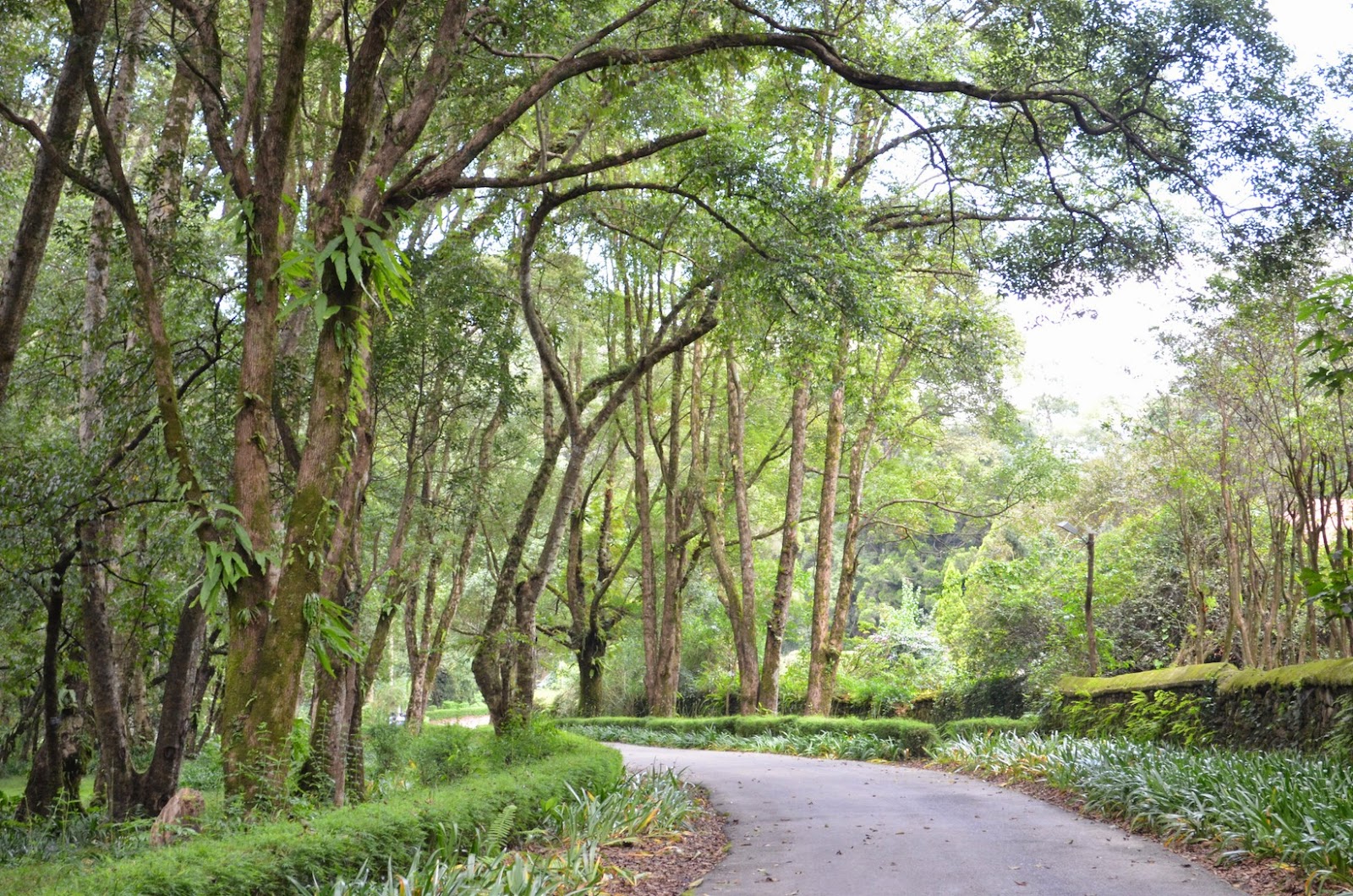
Close to the entrance, you have what is probably the cleanest, most lush street you will see in our city. It gives me the shivers because it feels like a street from some exotic foreign land. Never corresponds with my idea of Nepal. I love taking a picture from the exact same place every time I visit. It's not as breathtaking as the one I took last time, but it's still magical enough to bring to life the goblin within me.


My love for macro combined with my love for neglected corners. There is something I love about this photograph. I showed it to my colleague at work today and she said, "Eh, yo ta bigrechha hai?" I can't explain it to her, but that's probably what I love most about it.


So I have a clearer photograph of the same place, but I prefer this one. I like that it is diffused and dreamy. Mostly because it captures this restless mind's elusive desires. And gestures towards something like home. Although it's a really just a shabby little office within the botanical garden complex.


This is a flower. To think of the mass-produced, wide-petaled, crayon-scribbled flowers from our childhood. Yeah, flowers can be rebellious too. Also, the colours. The contrast. This will have to do until a macro lens helps me get more intimate with flowery things.


Orchid ko bot. Something about things being jangly and disconnected really tugs at my heart.


The lady conveyed such a strong sense of belonging to the nursery with all the baby plants. I like that she is turned away from me, ready to be consumed by her foliage-coated world.


Fern. Stylish. Sprigs of happiness. They give me so much comfort, sprouting here and there, reconquering the earth the way they do.


Another flower. This time the darkness in the background does the charm for me. Darkness - always so eager to tell its stories. If only we cared to listen.


Yet another flower. So we were inside the greenhouse aptly named 'decorative plants'. Looks like it'd make a fine print on one of Nana's kurtas. So pretty, in this translucenty way.


How did I manage to stumble upon this plant? It doesn't even look real. I love how much charm those little pale flower pods carry. An artist I met last January taught me that everything in nature gives colour to its neighbours. So when we draw, we must take care to colour in the reflection of certain things on certain other things. That's probably how this photograph managed to acquire a fourth dimension-like green-gray colour scheme.

Friday, September 27, 2013

aesthetics

i have surrounded my life in art
all my friends are artists or writers or geniuses of some sparkling kind or the other

their voices so loud
their words so beautiful
they'll carve you pretty pictures
and decorate it with their pain

but today, they all appear so naive to me

the truest of artists
the wisest
don't seem to create any art

they spend still, silent lives
in invisible corners

they will not do, but be

and their life is a storehouse of beauty
and every moment spent with them a revelation

i want more of that, please.


friends, how i wish we could all grow up.

Wednesday, September 25, 2013

rhymes of another summer (ii)

the same question it throws at me
again
and
again

how are we supposed to survive in a world packed with so much pain

where feeling is living
understanding, dying

where answers are the questions themselves
uncurling

where music is the mother that made me
now fading

where trying means to befriend
our failings

and what we are meant to gain
can never be whole
again.


how?

Monday, September 23, 2013

not unfamiliar ties

dearest,

look how love grows
like weed it spreads
without need

it sprouts in neglect
trusts inadequacies

every source
is contaminated with its whiff
it stinks

like stain
it sticks
remains


cause love is the only song the universe will sing, you know.


and the story you tell me is that
god is your friend

you pour your god words on me like water
mine i store like pebbles in the mouth
i will forever fumble

fail
to
feel

mouthful
and mute

you pour

and tender petals float along currents of a river
that slowly dissolve soundless stones.


you breathe

i melt into life.


love is your world
death is your cloak
you bow in prayer, that is your style

i will climb onto your lap
and play party to these rhymes
i will sail on your word
i will drown for a while
i will hold your hand
so we can dance to his song, once more.


i may have known you a long time, you know.


Sunday, September 22, 2013

mark your territory

often

loving
is
no more

than a dog taking a leak

Saturday, September 14, 2013

safe to say

the comma is a poet's best friend

Thursday, September 12, 2013

unintended inheritance

I may have been introduced to poems from when I was in the second grade, but it was only in ninth grade, as a 14-year-old, that I first encountered poetry. And it didn’t quite come in the form of a poem.

Yesterday I went up to our attic to look for pajamas and this is what I found.


It's a tattered copy of a copy of Black Boy, which is a childhood memoir of American writer Richard Wright. It's a photocopied version because that's what we were given in school, and that's how I read books through much of my childhood. Which is why it took a while getting accustomed to original copies of novels I had to read in college. This one has a spine made of yellow tape, and the cover page is covered with scribblings of the 14-year-old enthusiast I was. My name features six times, scattered across the cover, going off into every possible direction. There are sound words that, though written with innocence, are of a rather perverse nature. The mind has been stained irredeemably in the past decade. And there's some commentary on the muddy nature of the author's last name, which got me ruminating on ideas of right, wrong, guilt, etc, etc. The back cover is mostly gone.

I spent a better part of my high school years reading and rereading Black Boy as part of our literature class. It came to me at a time when I was sure school was a tiring and useless process, that I was certainly miscast in it. Most of eighth grade had passed without my taking a single look at the blackboard. I also felt general unease at the prospect of having to use the English language so profusely. A language I did not feel at home with. A language I had no confidence using. I wanted to badly quit school.

Like I mentioned earlier, I was introduced to poems very early in my childhood. And I began writing them when I was in the seventh grade. I'd carry a notebook with me everywhere I went. That's where I'd write, mostly in verses that rhymed, angry phrases filled with rage, anger, disappointment, humiliation. I'd write to get back at the world for not letting me in. In small hardcover notebooks, I chronicled all the little losses of my life, I tried to store all the things inside me that had remained misunderstood. The world was suffocation and writing easily became my refuge. It became my shield, my armour. But it was not poetry.

Last night, as I was flipping through pages of my tattered Black Boy, I encountered sentences, here and there, at random. And I was surprised by how they made me feel. Every turn of phrase, every progress in narrative carried a momentum, a sound, a rhythm that was oddly and intensely familiar. I remember it had given me a generous learning experience in school, one I eagerly plunged into. But back then I was barely aware of how much of an impact it was to leave on me.

In literature, I depend on and relish in style the most. Style is what gives a peek into the soul of the person behind the words. But style is always, at most, an abstract, intangible thing. And here, with Wright, even after a decade, style was like a life-sized statue placed in the middle of my bedroom. Black Boy has such a strong melody, that if you've spent a part of your youth playing it on repeat, you'll be able to hum it the rest of your life. Or that's what's been true for me. I feel like I can continue reading the book with my eyes closed. In that manner, the book is just like a 295 page-long song. It is one very, very long poem.

I quickly turned to pages that carry my favourite bits. These are lines that gave me the first inkling of what poetry means.

Each event spoke with a cryptic tongue. And the moments of living slowly revealed their coded meanings. There was the wonder I felt when I first saw a brace of mountain-like, spotted, black-and-white horses clopping down a dusty road through clouds of powdered clay.

There was the delight I caught in seeing long straight rows of red and green vegetables stretching away in the sun to the bright horizon.

There was the faint, cool kiss of sensuality when dew came on to my cheeks and shins as I ran down the wet, green garden paths in the early morning.

There was the vague sense of the infinite as I looked down upon the yellow, dreaming waters of the Mississippi River from the verdant bluffs of Natchez.

There were the echoes of nostalgia I heard in the crying strings of wild geese winging south against a bleak, autumn sky.

There was the tantalising melancholy in the tingling scent of burning hickory wood.

There was the teasing and impossible desire to imitate the petty pride of sparrows wallowing and flouncing in the red dust of country roads.

There was the yearning for identification loosed in me by the sight of a solitary ant carrying a burden upon a mysterious journey.

There was the disdain that filled me as I tortured a delicate, blue-pink crawfish that huddled fearfully in the mudsill of a rusty tin can.

There was the aching glory in masses of clouds burning gold and purple from an invisible sun.

There was the liquid alarm I saw in the blood-red glare of the sun’s afterglow mirrored in the squared panes of whitewashed frame houses.

There was the languor I felt when I heard green leaves rustling with a rainlike sound.

There was the incomprehensible secret embodied in a whitish toadstool hiding in the dark shade of a rotting log.

There was the experience of feeling death without dying that came from watching a chicken leap about blindly after its neck had been snapped by a quick twist of my father’s wrist.

There was the great joke that I felt God had played on cats and dogs by making them lap their milk and water with their tongues.

There was the thirst I had when I watched clear, sweet juice trickle from sugar cane being crushed.

There was the hot panic that welled up in my throat and swept through my blood when I first saw the lazy, limp coils of a blue-skinned snake sleeping in the sun.

There was the speechless astonishment of seeing a hog stabbed through the heart, dipped into boiling water, scraped, split open, gutted, and strung up gaping and bloody.

There was the love I had for the mute regality of tall, moss-clad oaks.

There was the hint of cosmic cruelty that I felt when I saw the curved timbers of a wooden shack that had been warped in the summer sun.

There was the saliva that formed in my mouth whenever I smelt clay dust potted with fresh rain.

There was the cloudy notion of hunger when I breathed the odour of new-cut, bleeding grass.

And there was the quiet terror that suffused my senses when vast hazes of gold washed earthward from star-heavy skies on silent nights...

Funny how poetry first happened to me in the form of prose. But look at these lines. How ripe they are with feeling, how willingly they offer themselves to your experience. There is memory, and warmth, and wonder, and curiosity, and pain, and pleasure. There is that child’s consciousness--which, like a camera roll, is forever changed with every single exposure to the world. There is nature nudging, inviting, nourishing, biting.

Language was often taught to us as a way of describing things, but these lines taught me how hollow description is when it is presented without feeling. You need distortion, bias, a description of reality layered with your experience of it, and your response to it, for poetry to come alive. Otherwise it will be another science textbook, one anyone could write.

There’s part II to these musical notes that come a bit later, when he’s slightly more grown up, although still very much a child.

The days and hours began to speak now with a clearer tongue. Each experience had a sharp meaning of its own.

There was the breathlessly anxious fun of chasing and catching flitting fireflies on drowsy summer nights. There was the drenching hospitality in the pervading smell of sweet magnolias.

There was the aura of limitless freedom distilled from the rolling sweep of tall green grass swaying and glinting in the wind and sun.

There was the feeling of impersonal plenty when I saw a boll of cotton whose cup had split over and straggled its white fleece towards the earth.

There was the pitying chuckle that bubbled in my throat when I watched a fat duck waddle across the back yard.

There was the suspense I felt when I heard the taut, sharp song of a yellow-black bee hovering nervously but patiently above a white rose.

There was the drugged, sleepy feeling that came from sipping glasses of milk, drinking them slowly so that they would last a long time, and drinking enough for the first time in my life.

There was the bitter amusement of going into town with Granny and watching the baffled stares of white folks who saw an old white woman leading two undeniably Negro boys in and out of stores on Capitol Street.

There was the slow, fresh, saliva-stimulating smell of cooking cotton seeds.

There was the excitement of fishing in muddy country creeks with my grandpa on cloudy days.

There was the fear and awe I felt when Grandpa took me to a sawmill to watch the giant, whirring, steel blades whine and scream as they bit into wet, green logs.

There was the puckery taste that almost made me cry when I ate my first half-ripe persimmon.

There was the greedy joy in the tangy taste of wild hickory nuts.

There was the dry, hot, summer morning when I scratched my bare arms on briers while picking blackberries and came home with my fingers and lips stained black with sweet berry juice.

There was the relish of eating my first fried fish sandwich, nibbling at it slowly and hoping that I would never eat it up.

There was the all-night ache in my stomach after I had climbed a neighbour’s tree and eaten stolen, unripe peaches.

There was the morning when I thought I would fall dead from fear after I had stepped with my bare feet upon a bright little green garden snake.

And there were the long, slow, drowsy days and nights of drizzling rain...

My familiarity with Wright’s style is not so much external as it is internal. The thing that my reading last night resonated with most was my own inner voice. And I was shocked to see how much the rhythm of my mind echoes his. The way he uses words and images, how he approaches language, what writing means to him. I hadn’t planned it to happen this way, but looking back, I see how much my obsession with the book, how the way it had salvaged the life of a hapless adolescent had left its imprint. It became my unintended inheritance.

The way I underlined lines on virtually every page, the scribbles on the sides show that there was something deep and wonderful ensuing. There’s this one page towards the end of the book where I’ve written in exasperation, “I don’t know…Shall I underline everything?!” At every turn, the book cracked open understandings that expanded the universe of my experience. New dimensions were revealing themselves to me, and with every read, the world I was living in felt big and mysterious and alluring. More explorable. More negotiable.

A book that charts the life of a black child growing up in the 1920s in the American South is undoubtedly not a light book. There is violence, betrayal, injustice at every corner. The book is packed with instances that are knotted with a complexity of emotional experiences, some excruciatingly painful, others achingly beautiful, others yet undoing all his life’s learnings only to teach him something entirely new. Looking back at his life and trying to measure its worth, Wright seems to have found something valuable in the suffering that formed the bedrock of his existence. That suffering must have deepened his joy, whenever he felt it, that he was able to create poetry out of it.

With this book in hand, I became aware that poetry isn’t just a mere wringing out the contents of your mind, but a fusion of your mind and your heart and your body and your people and your world. Was it at that moment that I changed--somewhat--from someone who wrote angry poems, to someone who started appreciating poetry?

My school life was mostly terrible, but having read Black Boy while I was there makes up for much of it. It taught me the most important thing about poetry--how to love it. And once that love develops, then the lived experience of poetry is no longer limited to a poem, or to words alone. It spills out of your consciousness through your senses and soon enough, the sky is singing to you, the rooftop breeze too. A lonesome tree. A cup of tea. A smile smiled in memory of a dear friend. The sparkle of gold, the mystery of mould. The carefree meandering of a river, the self-effacing patience of a silent stone on its banks. Endless journeys. Emotions that have no name. And on and on and on poetry seeps into every aspect of your life, until the whole world is drenched in melody. Poetry, when it becomes a way of life, enables you to grasp the rhythm of life.


So sing along. Until everything is just an unending song.